
 By
By You’re about to make a trade. You see a price on screen, hit confirm, and suddenly you get a different price. Welcome to slippage.
If you’ve traded crypto, you’ve probably experienced this frustrating moment. The price you wanted isn’t the price you got. Sometimes the difference is tiny. Other times, it can really hurt your wallet.
This guide breaks down everything about crypto slippage. You’ll learn what causes it, how to spot it coming, and practical steps to minimize it.
•• What Is Slippage in Crypto
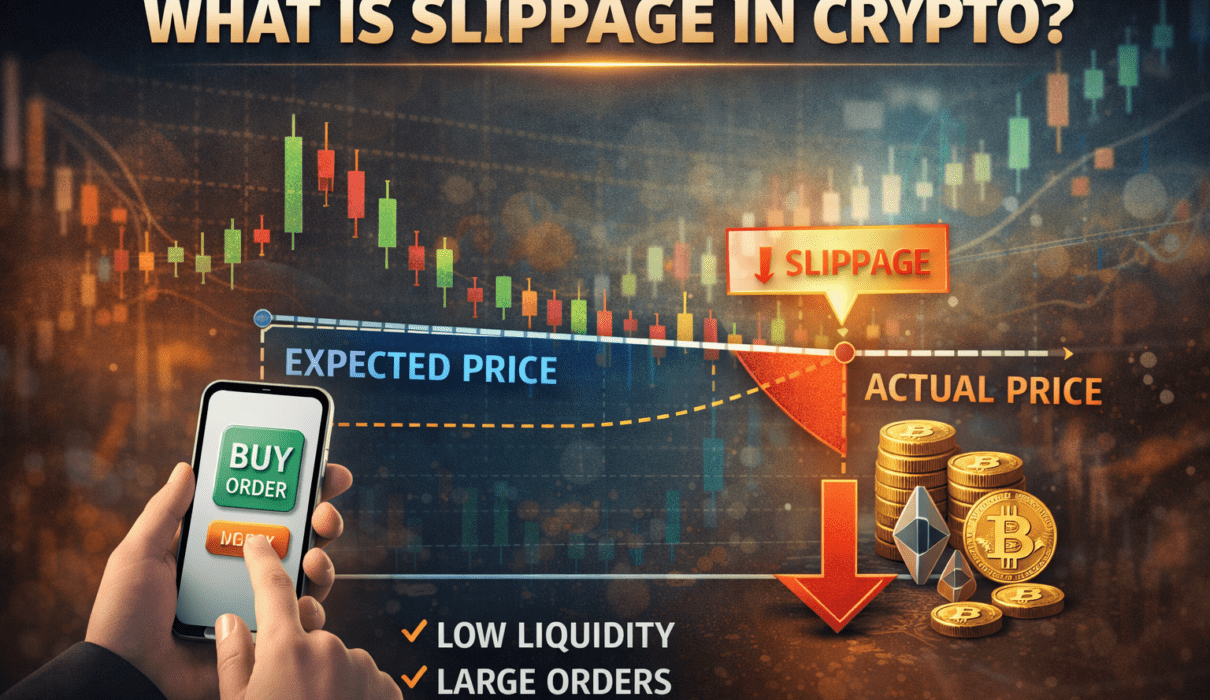
Slippage is the difference between the price you expect to pay and the price you actually pay. It happens because the market moves between when you submit your order and when it executes.
Think of it like this. You’re buying a used car listed at $10,000. By the time you show up with cash, someone else offered $10,500. You either pay more or miss out. That’s basically slippage.
In crypto markets, this happens constantly because prices change every second.
••• How Slippage Works in Practice
Let’s say you want to buy Ethereum at $2,000. You submit your order. But in the split second it takes to process, other traders have already bought at $2,000. Now the cheapest available ETH is $2,005.
Your order fills at $2,005 instead. That $5 difference is slippage. You experienced 0.25% slippage on this trade.
•• Types of Slippage
••• Positive Slippage
Yes, slippage can actually work in your favor. This happens when you get a better price than expected.
You submit an order to buy at $100, but the market moves down. Your order goes through at $99. You just saved a dollar per coin.
••• Negative Slippage
This is the painful kind. It means:
– You pay more than expected when buying
– receive less than expected when selling
You want Bitcoin at $50,000. By the time your order goes through, the price is $50,200. You just lost $200 on a single coin.
•• What Causes Slippage in Crypto
••• Market Volatility
Crypto prices move fast. Bitcoin can swing thousands in minutes.
During major news events, price swings get worse:
– Regulatory announcements
– Exchange hacks
– Major company news
– Economic reports
The more the market bounces around, the higher your slippage risk.
••• Low Liquidity
Liquidity means how easily you can buy or sell without moving the price.
– High liquidity = lots of buyers and sellers
– Low liquidity = few people trading
Bitcoin on major exchanges has tons of liquidity. But smaller altcoins? Your $5,000 buy could push the price up 10% or more.
••• Order Size
The bigger your order, the more slippage you’ll face:
– Small orders ($100) usually fill at one price
– Large orders ($100,000) grab from multiple price levels
– Professional traders split big orders into smaller pieces
••• Decentralized Exchanges
Platforms like Uniswap or PancakeSwap often have higher slippage. When you trade on these platforms, your transaction directly changes the available supply. Larger trades cause bigger price impacts.
•• How to Calculate Slippage
The formula is simple:
“Slippage (%) = ((Executed Price – Expected Price) / Expected Price) × 100”
••• Example for Buying
– Expected price: $1,000
– Actual price: $1,020
– Slippage = (($1,020 – $1,000) / $1,000) × 100 = 2%
••• Example for Selling
– Expected price: $500
– Actual price: $495
– Slippage = (($495 – $500) / $500) × 100 = -1%
•• How to Minimize Slippage
••• Use Limit Orders
Market orders execute right away at whatever price is available. Limit orders only execute at your chosen price or better.
If you set a limit buy at $1,000, you’ll never pay more. This is the single best way to avoid slippage.
••• Adjust Slippage Tolerance
Most exchanges let you set how much slippage you’ll accept:
– Set it too low: your trades won’t go through
– Set it too high: you might lose money unnecessarily
Recommended settings:
– Popular coins: 0.5% to 1%
– Smaller tokens: 5% or more
••• Trade High-Liquidity Assets
Stick to popular cryptocurrencies:
– Bitcoin
– Ethereum
– Top 20 coins by market cap
These have excellent liquidity and lower slippage.
••• Break Large Orders
Instead of one massive order, split it into smaller trades:
– Reduces market impact
– Saves money on slippage
– Worth it for orders above $10,000
••• Trade During High Volume
Trading when volume is highest reduces slippage:
– Check 24-hour volume first
– Avoid quiet periods (like early Sunday mornings)
– More participants = better prices
••• Choose the Right Exchange
Big exchanges offer better execution:
– Binance
– Coinbase Pro
– Kraken
Compare liquidity across platforms before trading.
•• Real Examples of Slippage
••• Example 1: Popular Coin
You buy $1,000 of Ethereum on Coinbase. Price shows $2,000. Executes at $2,003.
– Slippage: 0.15% or about $1.50
– Normal and acceptable
••• Example 2: Small Altcoin
You buy $5,000 of a small token with only $50,000 daily volume. Price shows $0.50.
Your order fills at multiple prices: $0.50, $0.52, then $0.55.
– Average execution: $0.53
– Slippage: 6% or $300
– Painful but common with low liquidity
••• Example 3: Market Crash
Bitcoin drops 5% on bad news. You panic sell $20,000 worth.
In the chaos, your order fills 2% lower than shown.
– Extra loss: $400 from slippage
– This is why limit orders matter
•• Common Slippage Mistakes to Avoid
••• Using Market Orders for Large Trades
Market orders guarantee execution but not price. For anything over $1,000, use limit orders.
- •• Ignoring Liquidity
Before trading, check:
– 24-hour trading volume
– Order book depth
If volume is thin, expect high slippage.
••• Setting Slippage Too High
Some traders set 10% or 15% tolerance. This is like putting a “rob me” sign on your wallet.
Bots will take advantage. Set reasonable limits.
••• Trading During News Events
Major announcements cause extreme price swings. Unless you’re a professional, wait for things to settle.
••• Not Checking Transaction Speed
On blockchains like Ethereum, slow transactions mean more time for prices to move. Pay adequate fees for faster confirmation.
•• Slippage vs. Spread
People often confuse these terms.
••• The Spread
The spread is the difference between the highest buy order and lowest sell order. It exists before you even place an order.
– Bitcoin bid: $49,995
– Bitcoin ask: $50,005
– Spread: $10
This is a visible cost you can see in advance.
••• How Slippage Differs
Slippage is unexpected price movement during execution. You can’t always predict it.
– Spread = constant at any moment
– Slippage = happens during execution
Both cost you money, but in different ways.
•• Tools to Monitor Slippage
••• Exchange Analytics
Most major exchanges show execution quality metrics:
– Coinbase Pro
– Kraken
– Binance
Review these after trades to track your patterns.
••• Slippage Calculators
Websites like DexScreener show expected slippage for different trade sizes. Use these before trading.
••• Trading Journals
Keep a simple spreadsheet tracking:
– Your trades
– Expected prices
– Actual executed prices
– Calculated slippage
You’ll learn which situations cause the worst slippage.
•• Slippage in Different Markets
••• Bull Markets
– Buying slippage: higher (everyone wants in)
– Selling slippage: lower (buyers are eager)
••• Bear Markets
– Selling slippage: higher (everyone exits)
– Buying slippage: lower (sellers are desperate)
••• Sideways Markets
Ranging markets have the lowest slippage. Prices move slowly, giving better execution.
••• Flash Crashes
During sudden crashes, slippage can be catastrophic. Your market order might fill at terrible prices.
•• Frequently Asked Questions
••• What is a good slippage percentage in crypto?
For major cryptocurrencies like Bitcoin and Ethereum, aim for under 0.5%. For mid-cap coins, 0.5% to 1% is reasonable. Low-liquidity altcoins might require 2% to 5%. Always use the lowest setting that allows your trades to execute.
••• How do I avoid slippage when buying crypto?
Use limit orders instead of market orders. Trade during high-volume periods, stick to liquid cryptocurrencies, and break large orders into smaller pieces. Set appropriate slippage tolerance and avoid trading large amounts on small coins.
••• Is slippage the same as transaction fees?
No. Transaction fees are charges for processing your trade. Slippage is the price difference due to market movement. Both reduce your returns but are separate costs. Always account for both when calculating total trading expenses.
••• Why is slippage higher on Uniswap?
Uniswap uses liquidity pools instead of order books. Your trade directly changes the token ratio in pools, causing price impact. The larger your trade compared to pool size, the more slippage. Regular exchanges often provide better execution for large trades.
••• Can slippage be positive?
Yes. Positive slippage happens when you get a better price than expected. You might buy during a quick price drop or sell into a sudden spike. While less common than negative slippage, it does occur and reduces your trading costs.
••• Does slippage affect stablecoins?
Stablecoins have much lower slippage because their prices stay near $1. However, you’ll still experience some, especially during market stress when stablecoins temporarily lose their peg. Expect 0.01% to 0.1% for most stablecoin trades.
••• How much slippage should I set on PancakeSwap?
Start with 0.5% for popular tokens. If your transaction fails, gradually increase to 1%, then 2%. For new or low-liquidity tokens, you might need 5% to 12%. Never set it above 15% as this exposes you to front-running bots.
••• What causes high slippage in crypto?
High slippage results from low liquidity (few traders), rapid price movement, large order size, trading during off-peak hours, or using platforms with small liquidity pools. News events and market crashes dramatically increase slippage everywhere.
•• Conclusion and Recommendations
Slippage is unavoidable in crypto trading, but you don’t have to be its victim.
The key is awareness. Know when slippage is likely and take steps to minimize it.
••• Key Takeaways
“Start with limit orders.” Only use market orders when you need immediate execution.
“Check liquidity first.” If 24-hour volume is low, expect high slippage.
“Split large orders.” Trading $50,000 at once costs more than ten $5,000 orders.
“Be patient.” Sometimes the best trade is the one you don’t make immediately. Wait for better conditions.
“Track your slippage.” Keep records of expected vs. actual prices. You’ll learn which coins and exchanges work best.
••• The Bottom Line
Slippage is one piece of your trading costs. When you add fees, spreads, and slippage together, you get the true cost of each trade.
The markets reward attention to detail. Slippage might seem small, but small things add up. Master this aspect of trading, and you’ll keep more profits in your wallet.